
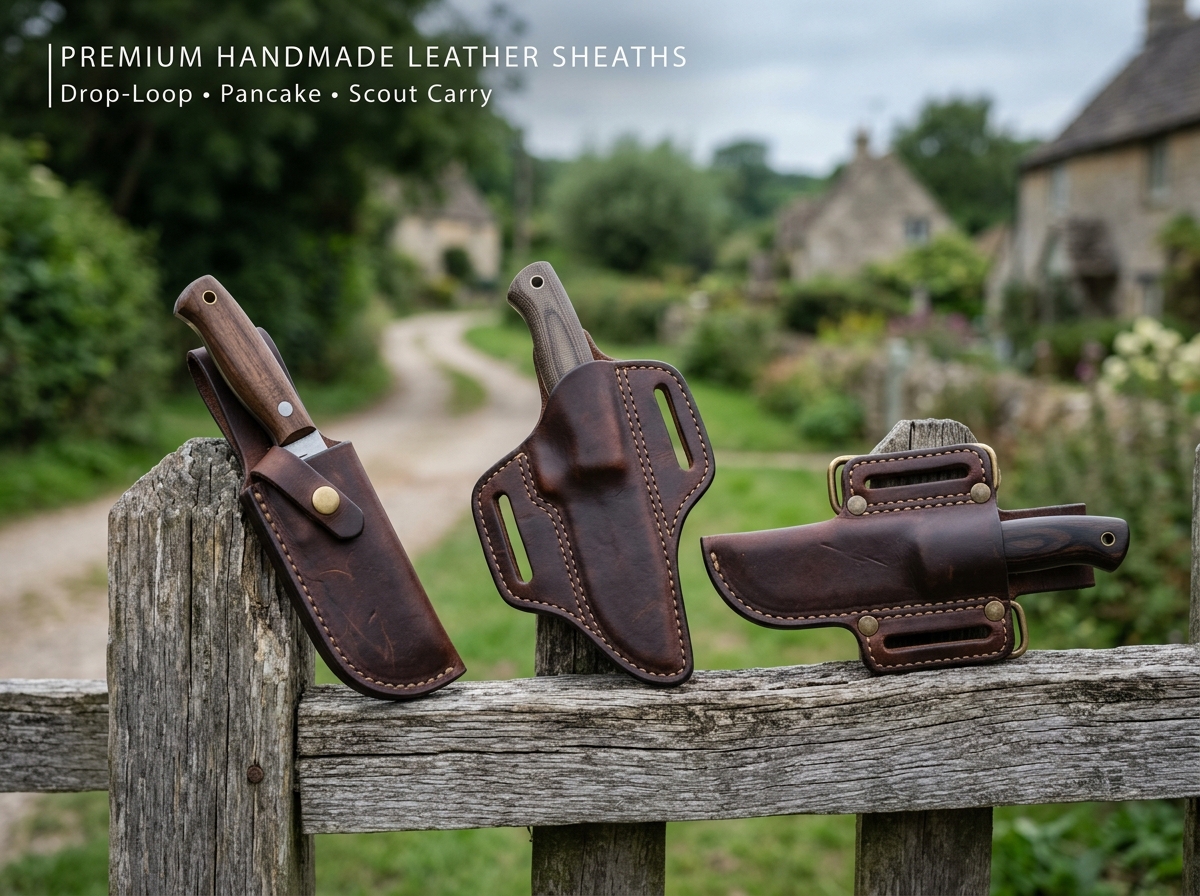
Acquiring specialized handmade leather knife sheath designs is a fundamental step toward securing user safety, field efficiency, and pristine edge retention. In demanding rural environments—whether clearing brush along an unpaved village path, handling livestock chores, or processing game—a bare knife blade or a generic synthetic sleeve is a severe liability. Mass-produced, factory-stamped slips lack the structural integrity, dense fiber wall thickness, and precise friction tolerances required to securely house a premium full-tang cutting tool.
Bespoke handmade leather knife sheath designs treat the carrier as a precise piece of personal safety armor. By engineering localized friction locks, integrating defensive safety welts, and balancing handle-to-blade weight ratios, custom leather artisans create housings that eliminate tool drop while presenting clean western aesthetics. This technical guide breaks down the three primary architectural designs of custom sheath making, ensuring you choose an alignment built for lifelong reliability in the great outdoors.
1. The Pouch / Drop-Loop Profile (The Traditional Standard)
The traditional drop-loop layout is the undisputed foundation of historical handmade leather knife sheath designs. This configuration features a deep, single-piece leather sleeve that swallows the blade and up to two-thirds of the handle scales, suspending the knife vertically below your belt line.
- Mechanical Advantage: By lowering the center of gravity, the drop-loop style lets the knife swing naturally with your leg movements. This prevents the handle from digging into your ribs or pinching your waist frame when sitting deep in a horse saddle or bending over to fix a fence line.
- Retention Method: It relies entirely on a deep, wet-molded friction fit. The dense, vegetable-tanned hide is massaged tightly over the handle bolster, creating a solid physical stop that locks the knife in place without needing mechanical snaps.
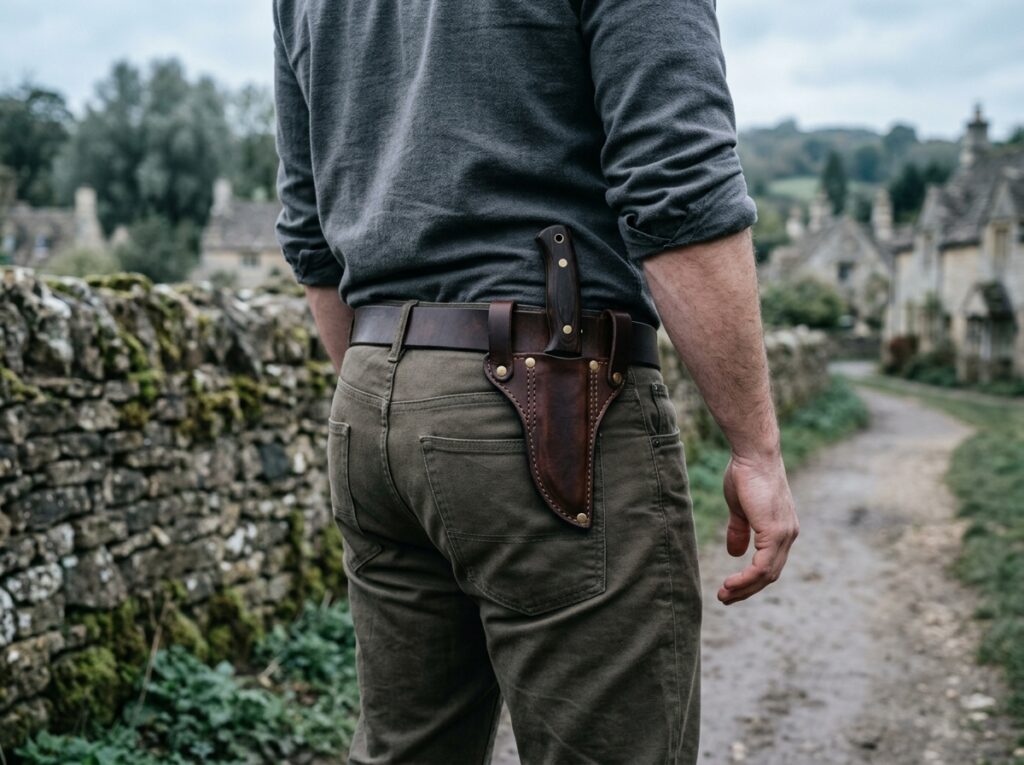
2. The Pancake Design (Low-Profile Concealment)
The pancake style is an advanced configuration built by sandwiching two independent, heavy-gauge leather panels together, with the knife chamber wet-molded directly in the center. The assembly is flanked by two wide, integrated belt slots cut directly through the outer wings.
- Mechanical Advantage: Because the belt pulls across the entire width of the leather wings, a pancake layout forces the entire sheath to curve tightly against your torso. This layout completely eliminates the vertical lever arm that causes standard sheaths to snag on equipment levers or thick trail brush, offering an exceptionally low profile.
- Retention Method: High-end pancake layouts leverage a dual-point friction capture system. The physical tension of your tightened work belt actively compresses the leather walls against the knife scales, keeping the tool perfectly stabilized during running or high-impact manual labor.
3. The Horizontal / Scout Carry Layout (Ergonomic Access)
The horizontal scout carry layout mounts parallel to your waist belt, typically positioned along the small of your back or directly across your front hip bone for a quick cross-draw deployment.
- Mechanical Advantage: Scout carry is optimized for total torso mobility. It completely clears your hips, allowing you to operate tractors, climb over corral fencing, or ride a horse without the lower tip of the sheath hitting your thigh. It also provides a true ambidextrous draw path.
- Retention Method: Because gravity pulls across the width of a horizontal opening rather than down into a vertical pocket, scout carry handmade leather knife sheath designs require strict mechanical retention. They combine a precision-molded guard throat with a heavy-duty leather strap locked by a solid brass or steel snap button.
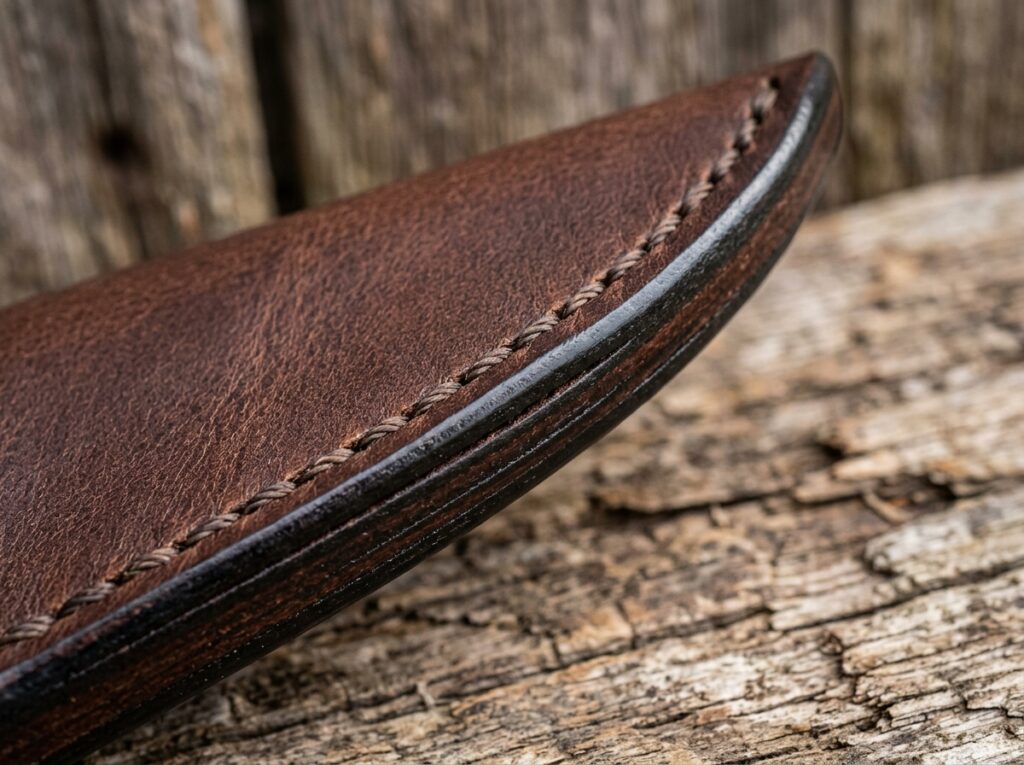
4. Technical Engineering Standards of a Master Custom Build
Regardless of which silhouette aligns with your daily field layout, a premium handmade build must fulfill three strict engineering requirements to protect your steel from catastrophic field failure:
| Structural Component | Engineering Standard | Operational Defense |
| The Multi-Layer Safety Welt | A separate 1/2-inch wide strip of thick cowhide glued and stitched firmly between the main face panels. | Thread Protection: Prevents the razor-sharp edge of your knife from cutting through the load-bearing saddle stitching during drawing or housing maneuvers. |
| Organic Vegetable Tanning | Hides processed exclusively with natural tree bark tannins, omitting all heavy chemical salts. | Corrosion Defiance: Unlike chrome-tanned leathers, vegetable-tanned fibers contain no residual chemical salts that absorb moisture and rust your blade steel during storage. |
| Hand-Sewn Saddle Stitching | A manual technique using two independent harness needles passing opposite ways through each punched hole. | Seam Integrity: If an external wire snag or sharp thorn snaps a thread on the trail, the opposite independent thread remains locked, preventing the entire seam from unraveling. |