
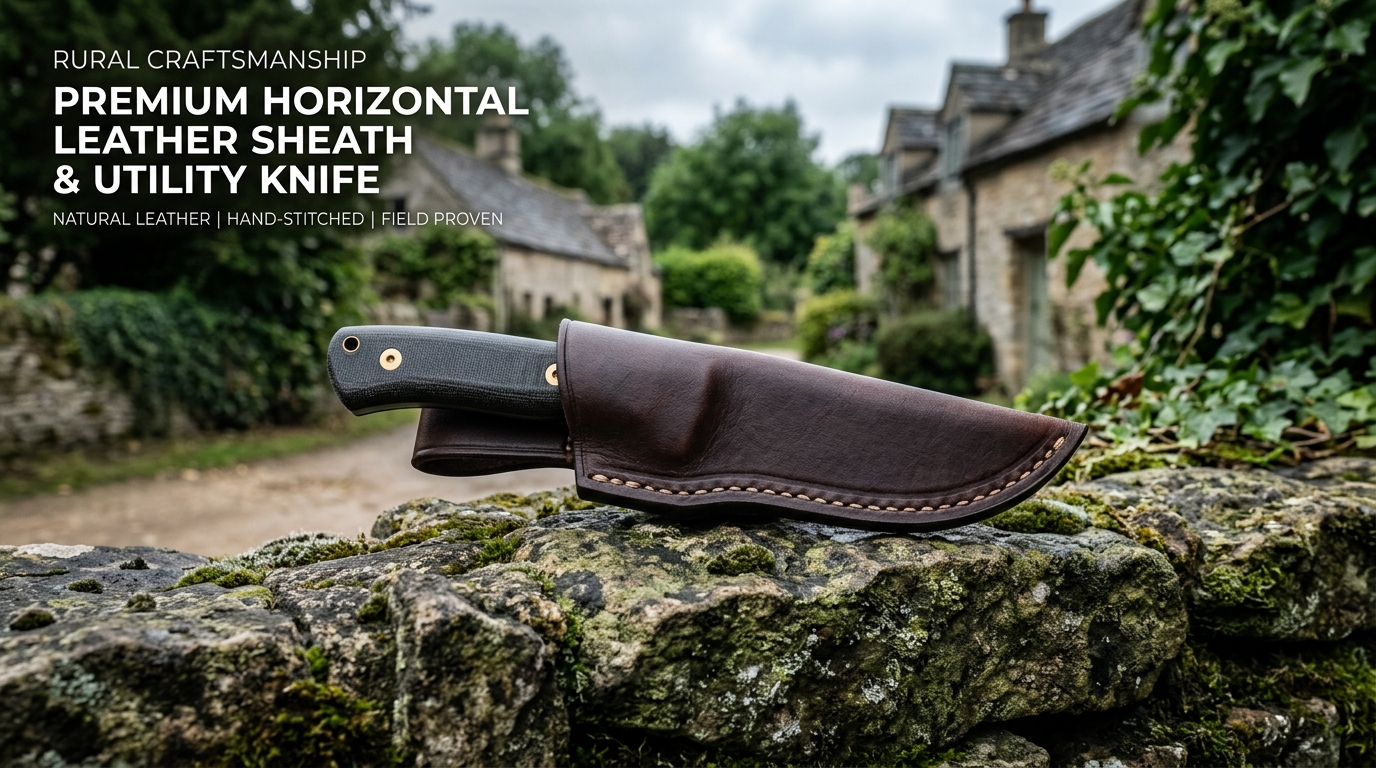
A fixed blade knife horizontal sheath—universally recognized in outdoor and tactical communities as a “scout carry” system—is one of the most efficient and comfortable hardware configurations for carrying a full-sized blade. Traditional vertical belt sheaths hang straight down past the waistband, causing the pommel to dig into your ribs when seated in a vehicle or riding a horse. Furthermore, vertical carry positions the blade where it can easily snag on dense brush, low-hanging branches, or agricultural fencing.
By rotating the blade 90 degrees so it sits parallel to your belt line, a horizontal sheath eliminates these spatial conflicts entirely. The knife contours seamlessly against the small of your back or across your front waistline, remaining entirely low-profile, balanced, and secure during dynamic physical labor. This comprehensive guide details the functional advantages of horizontal carry, material selection, and critical safety features to look for in a premium scout slip.
1. The Mechanical Advantages of Horizontal Scout Carry
Shifting your everyday carry (EDC) tool to a horizontal orientation alters the ergonomics of drawing, retention, and overall weight distribution:
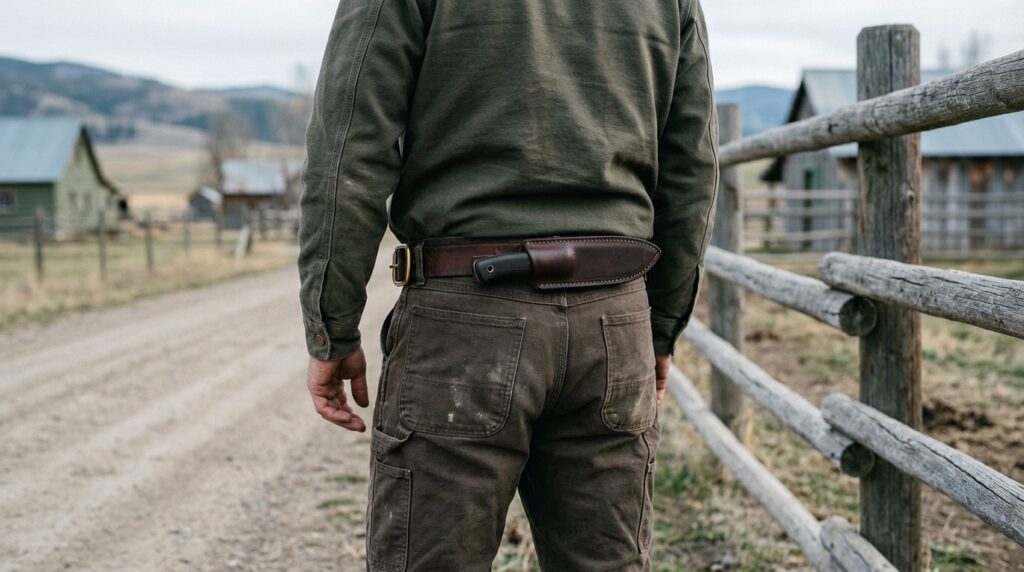
- Discreet, Low-Profile Footprint: A horizontal sheath keeps the knife tightly tucked against your body, as shown in the hardware profile above. This makes it an exceptional choice for working in crowded barnyards or navigating thick unpaved paths where an externally protruding vertical sheath would easily hook onto equipment.
- Unrestricted Torso Mobility: Because the sheath runs parallel to your waistband, it never interferes with your hip joints. You can bend completely forward to inspect livestock, sit comfortably in a farm vehicle for hours, or mount a saddle without the handle poking your torso or the tip catching on the seat.
- Ambidextrous Ergonomics: Horizontal sheaths can be easily repositioned along the belt line. Mounted on the small of the back, it allows for a rapid, ergonomic “scout draw” with your dominant hand. Alternatively, placing it at the front hip allows for a smooth, natural cross-draw configuration.
2. Onboarding Setup: Mounting and Configuring Your Sheath
Carrying a sharp fixed blade horizontally requires proper installation to maximize draw speed and guarantee absolute field safety. Follow this step-by-step mounting sequence:
1.Select Placement and Draw Direction:
Determine your optimal carry position along your belt. For a standard dominant-hand draw from behind, place the sheath over the small of your back with the handle pointing toward your dominant side. For a cross-draw setup, position it over your opposite hip with the handle angled forward.
2.Thread and Anchor the Dual Loops:
Open the heavy-duty directional snaps or unfasten the loop straps. Thread your thick work belt completely through both independent loop segments. Spacing the loops across a belt loop on your denim prevents the sheath from shifting laterally.
3.Lock the Secondary Retention Elements
Slide your fixed blade firmly into the molded container until the friction lock or mechanical indent engages. Wrap the secondary safety strap tightly around the handle bolster or finger guard, and snap it securely into place.
3. Tool Utility: Sheath Material Infrastructure Matrix
The choice of sheath material dictates how tightly the knife is retained and how well the setup handles environmental moisture on the ranch or trail:
| Performance Metric | Full-Grain Vegetable-Tanned Leather | Formed Kydex (Thermoplastic) |
| Drawing Acoustics | Virtually silent; organic surface dampens friction sounds during deployment. | Loud; produces a distinct plastic click upon draw and re-sheathing. |
| Retention Mechanism | Deep friction lock achieved via precise wet-molding; ages into a custom fit. | Rigid, mechanical snap retention; completely unaffected by climate shifts. |
| Blade Wear Profile | Gentle; soft fibrous interior protects polished blade finishes and edge sharpness. | Abrasive; rigid interior walls can score or wear down blade coatings over time. |
| Environmental Immunity | Requires periodic conditioning; can soften or absorb moisture if submerged. | Absolute; 100% waterproof and immune to mud, blood, oil, and sweat. |

4. Critical Safety Features and Retention Mechanics
Carrying a sharp fixed blade horizontally introduces unique gravitational stresses. If a sheath is poorly designed, physical movement could cause the knife to slide out sideways and injure the wearer. You must verify these safety elements:
The Mandatory Leather Welt
A high-quality custom leather sheath must feature a thick, internal leather welt glued and stitched precisely between the main panels along the cutting edge. This welt prevents the razor-sharp blade from slicing through the heavy waxed thread when you draw the knife horizontally.
Reinforced Dual Belt Loops
Never rely on a single belt loop for horizontal carry. A premium sheath utilizes two wide, independent belt straps equipped with heavy-duty solid brass directional snaps or permanent rivets. Dual loops distribute the weight of the knife evenly across your belt, preventing the sheath from sagging, twisting, or tilting under pressure.
Handle Retention Straps
For heavy fixed blades with pronounced handles, look for a sheath that includes a dedicated retention strap with a directional snap that wraps tightly around the finger guard or bolster. This guarantees the knife cannot be jostled free while running or working over rough terrain.
5. Routine Maintenance for Daily Utility
Because a fixed blade knife horizontal sheath sits close to your body, it is constantly exposed to natural body heat, perspiration, and trail dust.
- Internal Clearing: Every few months, remove the sheath from your belt and clear out any internal lint, grit, or dried mud using a dry cotton swab to prevent moisture retention inside the tip.
- Smooth Leather Hydration: For smooth-grain leather, apply a light coat of natural beeswax balm or high-quality leather conditioner to keep the hide supple and water-resistant.
- Stiffness Preservation: Never over-saturate the leather with heavy oils like neatsfoot, as maintaining a baseline structural stiffness is required to keep the friction-lock functioning safely.
- Blade Care Linkage: Keep your knife clean and apply a dedicated blade wax before sliding it home. This ensures it glides smoothly without dragging or leaving grease deposits against the interior hide.
6. Conclusion: Elevating Workspace Ergonomics
Transitioning to a fixed-blade horizontal sheath represents a major upgrade in everyday tool accessibility and personal comfort. By choosing a scout carry configuration constructed with a defensive leather safety welt, solid brass multi-loop mounts, and an accurate friction fit, you eliminate the constant hip-pinching and branch-snagging risks common to vertical slips. Applying deliberate, wax-based preservation steps ensures your tactical carry setup remains resilient, silent, and structurally secure through long shifts in any demanding environment.
Disclaimer: Edge retention metrics, leather break-in periods, and snap hardware life expectancies depend directly on hide thickness variations, custom mold tolerances, and active field exposure conditions. Standard markdown plain text formatting handles simple percentages and numbers like 10% or 180°C to guarantee clear, scannable reading layouts.